Why Y-Combinator Startups Are Building Core Engineering Hubs in Bengaluru
US senior engineers cost $220k+; Bengaluru product engineers cost $50k. Discover why venture-backed startups consolidate engineering in Indiranagar.
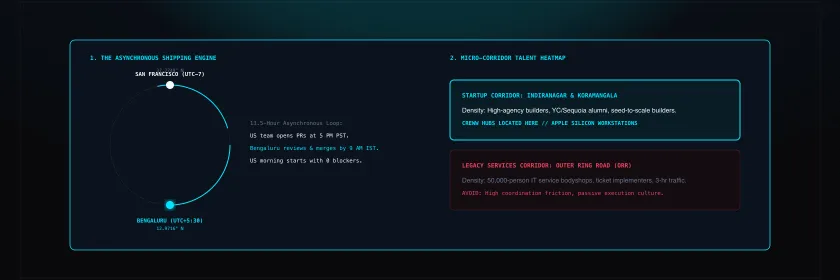
Executive Summary: For venture-backed Seed and Series A startups, engineering payroll in San Francisco or London ($180,000 to $240,000 base per senior engineer) consumes funding rounds in nine to twelve months. By consolidating engineering into a dedicated hub in Bengaluru, startups hire Senior L5 product builders at $42,000 to $66,000 USD (₹36L to ₹55L CTC), reducing net engineering burn by over 70% while extending runway from 12 to 32 months. By partnering with Creww, founders deploy high-ownership pods in Indiranagar with a flat $149/month EOR fee and 100% salary pass-through.
For early-stage technical founders, runway is not merely a financial metric. It is the number of architectural experiments, user iterations, and product pivots your startup can survive before running out of capital.
In San Francisco or New York, hiring four senior product engineers and a tech lead costs upwards of $1,000,000 to $1,200,000 annually once base salaries, payroll taxes, health insurance, and recruiting fees are factored in. For a $2.5M Seed round, that burns half your cash reserves in the first twelve months on payroll alone.
Global hiring is the obvious mathematical response.
Yet, many founders who attempt global hiring make a critical operational mistake: they scatter individual contractors across five different countries—one in Brazil, one in Poland, one in Nigeria, and two in India.
Within six months, the founder is spending three hours a day juggling timezone handoffs, chasing asynchronous communication gaps, and dealing with fragmented local labor laws.
The alternative adopted by high-velocity YC and venture-backed scaleups is hub concentration: consolidating remote engineering into a single, high-density tech corridor in Bengaluru.
1. The Micro-Geography of Bengaluru: Startup Corridors vs. IT Bodyshops
When Western founders hear “hiring in India,” they often imagine large legacy IT outsourcing corporations (Infosys, TCS, Wipro) that employ tens of thousands of maintenance programmers.
Understanding Bengaluru requires understanding its sharp geographic and cultural divide:
| Comparison Dimension | The Startup Corridors (Indiranagar, Koramangala, HSR) | The Legacy IT Outsourcing Parks (Whitefield, Electronic City) |
|---|---|---|
| Product Focus | Venture-backed product engineering | Legacy maintenance & IT services |
| Engineer Mindset | High-agency, product-minded builders | Passive ticket implementers |
| Alumni Network | Razorpay, CRED, Swiggy, Zepto, Postman | Legacy 90-day waterfall delivery corporations |
| Technology Stack | Modern stacks: Go, Rust, React, AI infrastructure | Legacy enterprise monoliths & XML |
| Work Environment | Dedicated physical hubs in central startup districts | Distant campus complexes on outer ring roads |
The top 5% of product engineers in India do not work at legacy IT outsourcing firms on the outskirts of the city. They cluster in central startup neighborhoods like Indiranagar and Koramangala.
These engineers have spent years building and scaling consumer and B2B products for high-growth tech companies (including unicorns like Razorpay, Swiggy, Zepto, and Postman). They write automated integration tests, design distributed caching layers, and challenge underspecified user stories because they are accustomed to rapid shipping cycles.
Sourcing in Bengaluru is not about browsing general job boards; it is about cultural immersion in these specific startup districts.
2. The Hard Data: 2026 Compensation & Runway Extension Math
To plan your hiring budget defensibly, examine true 2026 compensation data for product engineers in Bengaluru:
| Engineering Level & Role | Experience | Annual CTC (INR) | USD Equivalent (Annual) | SF Equivalent (Base + Burden) | Net Annual Burn Savings |
|---|---|---|---|---|---|
| Mid-Level Fullstack / Backend | 3–5 Years | ₹24,00,000 – ₹35,00,000 | $28,000 – $42,000 | $160,000 – $190,000 | ~$140,000 (78%) |
| Senior L5 Product Engineer | 5–8 Years | ₹36,00,000 – ₹55,00,000 | $42,000 – $66,000 | $200,000 – $240,000 | ~$165,000 (72%) |
| Staff / Founding Engineer (L6) | 8+ Years | ₹55,00,000 – ₹80,00,000+ | $66,000 – $96,000 | $250,000 – $320,000 | ~$195,000 (68%) |
| AI / ML Infrastructure Specialist | 4–8 Years | ₹50,00,000 – ₹75,00,000 | $60,000 – $90,000 | $260,000 – $350,000 | ~$220,000 (72%) |
The Runway Multiplier in Practice
Consider a Seed-stage startup with $2,000,000 in available cash:
- Option A (All-US Team): 4 Senior Engineers in SF = $920,000/year. Runway: ~18 months (factoring in operational overhead).
- Option B (The Hub Model): 1 US Lead in SF ($230,000) + 3 Senior L5 Engineers in Bengaluru via Creww ($160,000 total) = $390,000/year. Runway: ~38 months.
The hub model provides twenty additional months of runway. That time allows your engineering team to iterate through product feedback, find product-market fit, and approach Series A investors from a position of commercial strength rather than runway desperation.
3. The Operational Blueprint: Managing the Golden 3-Hour Overlap
A common question among Western technical leaders is how to manage cross-border timezones without burning out team members with late-night meetings.
The answer lies in adopting structured asynchronous collaboration centered on the Golden 3-Hour Overlap Window:
| Collaboration Zone | Western HQ (US East & Europe) | Bengaluru Engineering Pod (12:00 PM – 8:00 PM IST) |
|---|---|---|
| Active Local Hours | 9:00 AM – 12:00 PM EST / 2:00 PM – 5:00 PM GMT | 6:30 PM – 9:30 PM IST / 4:30 PM – 7:30 PM IST |
| High-Bandwidth Syncs | Architectural reviews, design handoffs, blocker resolution | Daily standups, sprint planning, live pairing |
| Deep Work Focus | Morning execution & product roadmapping | Afternoon deep coding with zero Slack interruptions |
1. Shift to a 12:00 PM – 8:00 PM IST Schedule
Senior engineers in Bengaluru prefer working midday to evening schedules, avoiding morning commute traffic. This naturally aligns their working hours with European afternoons (4 to 5 hours of direct overlap) and US East Coast mornings (2.5 to 3 hours of direct overlap).
2. High-Bandwidth Overlap Syncs
Reserve the 3-hour overlap window strictly for high-context discussions: sprint planning, architectural trade-offs, and live PR reviews.
3. Continuous Asynchronous Commits
During US nighttime hours, your Bengaluru team operates with uninterrupted focus. They build features, execute test suites, and open PRs. When your domestic team comes online in the morning, new pull requests are ready for review, creating a continuous 24-hour development cycle.
4. Addressing the Skeptic: Overcoming Common Objections
“Will an engineer in Bengaluru have the product sense to understand Western customers?”
If you hire an engineer from a legacy IT maintenance bodyshop, they will likely struggle with product intuition because their career rewarded adherence to rigid specifications.
However, if you source engineers who built consumer-facing apps or high-throughput fintech platforms at Indian product unicorns (such as CRED or Razorpay), product thinking is second nature. They analyze conversion funnels, debate UX decisions, and look at instrumentation metrics as part of their standard engineering workflow.
“Isn’t it easier to hire contractors on Upwork or Turing?”
Renting contractors through freelance platforms creates high turnover and fragmented codebases. Independent contractors juggle multiple clients and have zero equity alignment.
By building a dedicated hub through Creww, your engineers are full-time team members. They receive top-of-market compensation, brand-new Apple hardware, dedicated coworking desks, and complete statutory benefits—giving you the loyalty and context accumulation of a permanent engineering team.
Statutory & Empirical Verification
Every regulatory statement, tax model, and statutory citation in this analysis is anchored in published legal frameworks, official gazettes, or judicial precedents. Review the primary sources below:
Karnataka Industrial Policy 2020-2025 — IT/ITeS Policy Framework
Delineates infrastructure subsidies, tech corridor development, and fiscal incentives across Bengaluru tech clusters.
Reserve Bank of India (RBI) Bulletin — Payment Systems and UPI Transaction Volumes
Empirical data documenting 14+ billion monthly real-time digital banking transactions engineered locally in Bengaluru.
Connected Operational Blueprints
Explore interconnected field manuals to navigate technical, legal, and economic decisions across this topic cluster:
Where Top Engineers Actually Live: Indiranagar & Koramangala vs Whitefield & Outer Ring Road
Strategic Context: Where top builders live: Indiranagar and Koramangala versus Outer Ring Road traffic corridors.
2026 Bengaluru Startup Engineering Compensation Index: Real USD & INR Benchmarks for L3–L6 Roles
Strategic Context: Verified 2026 compensation data and percentiles for product, full-stack, and systems architects.
Can You Hire 'Founding Engineers' in Bengaluru? What Unicorn Builders Demand
Strategic Context: Evaluating the depth of 0-to-1 engineering leadership and architectural conviction in Bengaluru.
Ready to build your core engineering hub in Bengaluru?
Stop paying 60% agency markups or gambling on unvetted contractors. Creww matches venture-backed startups with the top 1% of product engineers in Bengaluru—with 100% transparent pass-through pricing and complete operational support.