Creww vs. Turing vs. Toptal: Why Contractor Marketplaces Suffer 40% Churn
Contractor marketplaces take 40-60% markups and treat engineers like hourly commodities. Compare marketplaces with Creww’s pass-through engineering hubs.
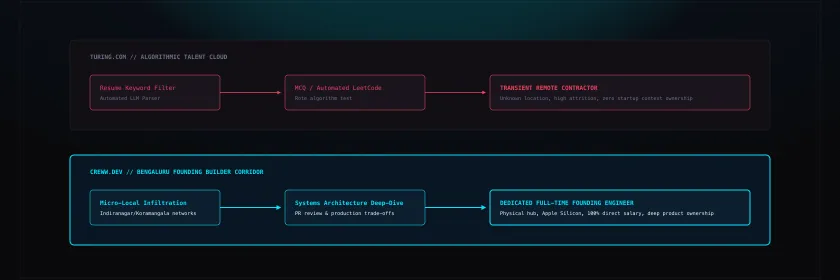
Executive Summary: When you need a specialized developer for a six-week project, freelancer marketplaces like Turing and Toptal offer fast, on-demand capacity. However, if you are building core product architecture, relying on contractor platforms creates severe friction: marketplaces take a 40% to 60% hidden margin spread, enforce invasive screenshot surveillance software, and suffer from over 40% annual developer turnover. Creww provides an open-book alternative for venture-backed startups: 100% transparent salary pass-through, a flat $149/month EOR fee, zero surveillance tools, and dedicated physical hubs in Bengaluru—saving founders over $64,000 per engineer annually while securing long-term technical retention.
The marketing pitch from talent marketplaces sounds deceptively convenient to an overburdened startup founder: “Push a button, and a pre-vetted developer starts writing code tomorrow.”
When your engineering pipeline is backlogged and local hiring is moving at a crawl, the prospect of instantly spinning up on-demand contractors is seductive.
However, consider what happens six months down the line.
You review your GitHub activity and notice that the contractor who wrote your core billing integration has abruptly rotated off the platform. Their replacement is struggling to parse undocumented architectural shortcuts. Meanwhile, your monthly invoice from the marketplace bills you $65 to $90 per hour—yet you discover the developer was taking home less than half that amount.
This dynamic illustrates why venture-backed startups outgrow freelance platforms: marketplaces are optimized for transactional capacity, not context accumulation.
1. The Commodity Trap: Why Hourly Marketplaces Suffer 40%+ Churn
To understand why developer turnover on contractor marketplaces is structurally high, examine the psychological and economic relationship between the developer and the platform.
| Marketplace Architecture Element | Resulting Engineering Behavior on Your Codebase |
|---|---|
| 40% to 60% Hidden Margin Spread | Developer feels underpaid, disengaged, and quietly juggles second client gigs |
| Hourly Billing with Time-Tracking | Developer focuses on logging billable hours rather than simplifying architecture |
| Keystroke & Screenshot Surveillance | Treats creative engineering like factory labor, destroying morale and initiative |
| Contractor Status with Zero Equity | Zero psychological co-ownership; developer leaves the moment a better offer appears |
| $25,000+ Buyout Penalty Clauses | Founders locked into ongoing marketplace markups with high conversion barriers |
The Psychological Degradation of Surveillance Software
Many talent marketplaces require developers to install desktop tracking applications that record keystrokes, track active mouse movements, and take periodic webcam or desktop screenshots to “verify” billing.
Reflect on what this practice communicates to a senior product engineer: it treats an intellectual creator like an assembly-line factory hand.
High-agency engineers—those who challenge assumptions, simplify architecture, and care about system reliability—refuse to work under continuous keystroke surveillance. The engineers who tolerate it are often those with low market leverage who optimize for one metric: keeping the activity bar green to bill hours.
The Context Evaporation Problem
In software development, code is only a fraction of what an engineer contributes. The greatest asset a developer accumulates is organizational context: understanding why past architectural decisions were made, how edge cases affect real customers, and which technical debt is safe to ignore.
When a freelancer leaves your project, that context evaporates. Replacing them with another hourly contractor forces your team to pay the onboarding tax all over again.
2. The Economic Comparison: Turing / Toptal vs. Creww Pass-Through
Marketplaces frequently market their pricing as “all-inclusive,” obscuring how much capital is siphoned away from the actual engineer.
Here is what the real financial model looks like for a Senior L5 Engineer working 160 hours per month:
| Operational Dimension | Hourly Marketplace (Turing / Toptal) | Creww Pass-Through Model |
|---|---|---|
| Billing Model | Hourly rate with built-in margin spread | 100% Salary Pass-Through + Flat Fee |
| Client Cost (Senior L5) | $10,400 / month ($65/hr) | $4,649 / month ($4,500 salary + $149 EOR) |
| Developer Take-Home | $4,500 – $5,500 / month | $4,500 / month (100% of agreed salary) |
| Intermediary Spread | 45% – 55% taken by platform | $0 wage mark-up (Flat $149/mo EOR) |
| Performance Oversight | Invasive time-tracking & screenshot logs | Merged PRs, system design, sprint milestones |
| Contractor Buyout Fee | $25,000 – $40,000 penalty clause | $0 (Clean unencumbered transfer) |
| Annual Year 1 Cost | $124,800 | $60,588 (Includes sourcing & EOR) |
| Net Annual Savings | $0 (Baseline) | $64,212 (51% burn reduction) |
By eliminating the platform margin, you save $64,212 annually per engineer while giving that developer top-of-market compensation and genuine stability.
3. The Buyout Barrier: How Marketplaces Lock In Founders
When a founder finds a marketplace contractor who performs exceptionally well, the immediate desire is to transition them into a permanent employee with stock options.
That is when the marketplace invokes their Conversion or Buyout Clause:
- Standard marketplace MSAs require the client to pay $25,000 to $40,000, or up to 30% of the engineer’s annualized compensation, to convert them into a direct employee.
- If you refuse to pay, the platform restricts the developer from working with you directly for twelve to twenty-four months under non-solicitation covenants.
At Creww, we believe talent hostage clauses are counter-productive. If your startup reaches a stage where incorporating a direct Indian subsidiary makes financial sense, your engineers transfer to your entity with zero buyout fees after 24 months.
4. The Operational Blueprint: Moving from Renting to Owning
Building a long-term core team requires three fundamental shifts in how you structure remote technical work:
| Phase | Marketplace Approach | Creww Pass-Through Approach |
|---|---|---|
| Vetting | Automated coding puzzles easily gamed by candidates | Real-world code reviews by active Staff Engineers |
| Compensation | Platform pockets 50% spread; developer feels squeezed | 100% of budgeted salary goes directly to the builder |
| Culture | Isolated contractor in bedroom looking for next gig | Dedicated coworking desk in Indiranagar startup community |
| Outcome | Fragile codebase with high context turnover | Permanent organizational knowledge that scales with your round |
1. Shift from Hourly Logging to Milestone Delivery
High-performing engineers are motivated by ownership, not surveillance. By paying a transparent monthly salary, you align incentives: the engineer is rewarded for writing clean, maintainable systems that require less maintenance, rather than inflating ticket hours.
2. Equalize Hardware and Tooling
Do not expect an engineer to build production systems on an unmanaged personal laptop. Creww provisions brand-new Apple Silicon MacBooks locally in Bengaluru at actual invoice cost plus a flat 2% logistics fee, ensuring security and performance from Day 1.
3. Provide Physical Workspace Density
Remote work from an apartment often leads to cognitive fatigue and social isolation. Creww provides dedicated desks at curated coworking hubs in Indiranagar and Koramangala, giving your team enterprise-grade infrastructure and an environment surrounded by other ambitious builders.
5. Addressing the Founder’s Core Dilemmas
“What if we only need an engineer for three months?”
If your requirement is truly temporary—such as a short-term infrastructure audit or a temporary burst of capacity before an upcoming release—a marketplace like Turing or Toptal is the right choice. Pay the hourly premium for their elasticity.
However, if you are building the foundation of your core product, renting contractors creates compounding technical debt. Build a dedicated squad with Creww instead.
“How do we ensure performance without time-tracking software?”
You evaluate remote engineers the exact same way you evaluate senior engineers in your domestic office:
- Are their pull requests well-structured, thoroughly tested, and promptly reviewed?
- Do they communicate blockers asynchronously during overlap hours?
- Does their architecture scale predictably under user load?
If you need a keystroke logger to verify whether an engineer is working, you have an evaluation problem, not a productivity problem.
Statutory & Empirical Verification
Every regulatory statement, tax model, and statutory citation in this analysis is anchored in published legal frameworks, official gazettes, or judicial precedents. Review the primary sources below:
Supreme Court of India Ruling — Ram Singh & Ors. v. Union of India (2004)
Established the 'Supervisory Control and Economic Reality' test to classify genuine employment versus independent contractors.
Information Technology Act, 2000 — Section 43A (Data Protection Rules)
Mandates reasonable security practices and procedures for bodies corporate handling sensitive personal data.
Connected Operational Blueprints
Explore interconnected field manuals to navigate technical, legal, and economic decisions across this topic cluster:
Why We Don't Use LeetCode: Our Live System Design and Codebase Navigation Rubric for L5 Engineers
Strategic Context: Why automated multiple-choice tests and algorithmic LeetCode fail to predict production software delivery.
The Distributed Panel: Why Peer Technical Reviews by Active Principal Engineers Beat Recruiter Screens
Strategic Context: Evaluating systems architects through live codebase PR review drills rather than black-box algorithms.
The Hidden Buyout Fees and Conversion Traps in Developer Contracts
Strategic Context: The hidden economic, operational, and retention costs of algorithmic matching marketplaces.
Ready to build your core engineering hub in Bengaluru?
Stop paying 60% agency markups or gambling on unvetted contractors. Creww matches venture-backed startups with the top 1% of product engineers in Bengaluru—with 100% transparent pass-through pricing and complete operational support.