Creww vs. Deel: Why Software EOR Platforms Fail at Retaining Senior Indian Engineers
Deel charges $599/mo for payroll rails, leaving sourcing and retention unsolved. Compare Deel with Creww’s transparent $149/mo Bengaluru model.
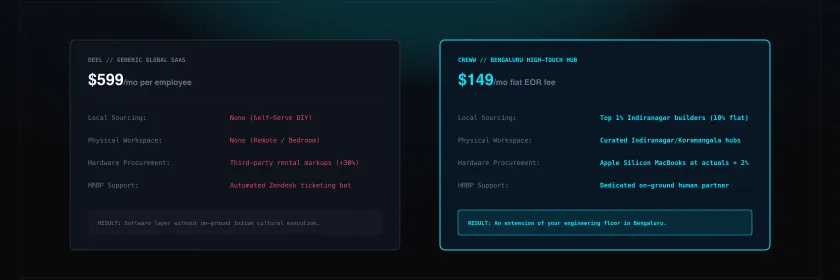
Executive Summary: If your startup needs to employ individual non-technical team members across ten different countries, Deel is the market standard for self-serve cross-border compliance. However, if your objective is to build and retain a dedicated software engineering team in Bengaluru, Deel’s $599/month per employee software fee only provides legal rails—leaving sourcing, technical vetting, hardware logistics, and culture completely unsolved. Creww provides an integrated tech partner model with peer technical screening, dedicated coworking hubs in Indiranagar, and a flat $149/month EOR fee, saving venture-backed startups over $5,400 per engineer annually while cutting turnover.
If you have ever hired an engineer in India through a global Employer of Record platform, you know the quiet disconnect that follows the offer signature.
The contract is legally compliant. The monthly payroll runs automatically. The tax forms are filed.
Yet, three months into the engagement, you realize the engineer feels completely isolated. They sit in an apartment in Bengaluru, interacting with your company solely through Slack notifications and a generic SaaS dashboard where they download monthly payslips. When power cuts disrupt their home connection or an unvetted ticket stalls in review, there is no on-ground team to step in.
Within ninety days, the engineer quietly accepts an offer from a local product startup with a physical office and a peer group.
You are left holding a compliant contract for an empty seat.
This is the central limitation of global software EORs: compliance is a solved software problem; engineering retention is an on-ground human problem.
1. What Deel Actually Solves (And Where the Boundary Lies)
To evaluate Deel fairly, understand what their platform was architected to do.
Deel built an exceptional global payroll engine. If your US startup needs to hire one sales representative in London, one customer support specialist in the Philippines, and one account manager in Germany, Deel makes that frictionless. Managing thirty distinct labor codes through a single software interface is a major operational achievement.
| Platform Layer | What Deel Solves (The Legal Rails) | What Builds an Engineering Team (Creww) |
|---|---|---|
| Legal & Entity | Compliant Indian employment entity | Compliant Indian employment entity + $149/mo flat EOR fee |
| Tax & Payroll | Local tax withholding & PF filings | Transparent pass-through payroll; zero salary markups |
| Technical Vetting | None (You source and screen every applicant) | In-depth architectural code screens by active Staff Engineers |
| Sourcing Pool | Unvetted applicant queue | Sourced directly from top-decile product startups (Razorpay, Swiggy) |
| Workspace & Hardware | None (Engineer works isolated in bedroom) | Dedicated physical desks in Indiranagar & Apple hardware at actual cost |
The breakdown occurs when founders treat a global payroll platform as an engineering strategy.
Software cannot evaluate whether a backend engineer understands distributed cache invalidation or merely memorized LeetCode interviews answers. Software cannot prevent an engineer from feeling isolated when working across a twelve-hour timezone gap. And software does not provide a physical desk surrounded by high-performing peers.
2. The Operational Dilemmas of the Self-Serve Model
When a venture-backed startup relies on a generic EOR platform to hire engineers in India, three hidden operational burdens fall entirely on the founder’s shoulders:
| Stage in Contractor Lifecycle | What Software EORs Automate | The Human Reality on the Ground |
|---|---|---|
| 1. Candidate Sourcing | Web form to enter contractor details | Founder spends 40+ hours filtering uncalibrated resumes |
| 2. Technical Vetting | None | Non-technical tests fail to detect architectural depth |
| 3. Daily Work Life | Automated monthly ACH invoice debit | Engineer sits isolated in home bedroom with power cuts |
| 4. Long-Term Retention | Automated contract generation | Engineer leaves within 8 months for local startup pod |
1. The Sourcing Vacuum
Deel provides the entity to employ someone, but you have to find that person.
Founders typically end up posting on LinkedIn or engaging third-party recruiters who charge 20% to 25% of the engineer’s first-year salary. Because these recruiters lack technical depth, your CTO spends forty hours reviewing resumes and conducting introductory screens just to identify one viable candidate.
2. The Hardware Customs Trap
Foreign founders frequently attempt to purchase a MacBook in San Francisco or London and ship it to an engineer in Bengaluru via DHL or FedEx.
Indian customs authorities classify imported commercial electronics strictly. Without a registered Indian importer code, laptops are routinely impounded at Bengaluru airport customs, accruing storage fees and requiring up to 42% in import tariffs and duties, plus weeks of documentation delays.
Deel leaves hardware logistics to the client. Creww procures brand-new Apple Silicon MacBooks locally in Bengaluru at actual invoice cost plus a flat 2% logistics fee, delivering the machine pre-configured on Day 1.
3. The “Spreadsheet Row” Syndrome
When an engineer works through a global platform, their relationship with your startup is entirely mediated by software.
They do not have a dedicated HR Business Partner in their city. They have no physical hub to visit when their home internet experiences an outage. They exist as an entry in an administrative ledger. When a local company offers them an opportunity to build alongside colleagues in an Indiranagar office, they take it.
3. Direct Economic Comparison: Deel vs. Creww
The financial contrast between a self-serve global platform and a focused local partner is substantial:
| Operational Dimension | Deel (Global EOR Platform) | Creww (Bengaluru Tech Partner) |
|---|---|---|
| Monthly Management Fee | $599 / month per employee | $149 / month per employee |
| Salary Mark-Up | 0% (Client sets salary) | 0% (100% pass-through) |
| Technical Sourcing | Self-serve (or add-on 20–25% agency fee) | Integrated headhunting (10% one-time fee) |
| Technical Screening | None (Founder conducts all screens) | Peer-level screens by active Staff Engineers |
| Hardware Procurement | Client ships (42% import duty risk) | Local Apple procurement at actuals + 2% |
| Physical Infrastructure | None (Home work only) | Dedicated desks at WeWork/BHIVE Indiranagar |
| On-Ground Culture | None | Dedicated HRBP, quarterly team offsites |
| Annual Year 1 Cost (Senior Dev) | $7,188 EOR + $13,500 agency fee = $20,688 | $1,788 EOR + $5,400 sourcing fee = $7,188 |
| Annual Ongoing Cost (Year 2+) | $7,188 / year | $1,788 / year (Save $5,400/yr per dev) |
For a team of four senior engineers, using Creww saves your startup $21,600 every year in EOR platform fees alone, while eliminating external recruiter commissions and hardware customs delays.
4. The Micro-GCC Alternative: How Creww Structures the Relationship
Creww functions as an on-ground operational partner rather than an impersonal software tool:
| Infrastructure Layer | Creww Operational Delivery | Founder Advantage |
|---|---|---|
| 1. Curated Sourcing | Headhunted exclusively from top-decile product tech firms | 3 calibrated profiles in 14 days; zero agency markups |
| 2. Physical Coworking Hub | Premium desks in Indiranagar / Koramangala | High retention, fast internet, in-person engineering camaraderie |
| 3. Apple Hardware | Brand-new M3/M4 MacBooks procured locally at actuals + 2% | Zero customs delays; day-one developer onboarding |
| 4. Flat-Rate EOR | Flat $149/mo EOR fee with 100% salary pass-through | Saves $450/mo per dev compared to legacy software platforms |
1. Peer-to-Peer Technical Evaluation
Instead of non-technical recruiters matching keywords, Creww utilizes a Distributed Technical Panel composed of active Staff and Principal Engineers from leading Indian startups (Razorpay, Swiggy, Flipkart). They evaluate candidates on production architectural judgment, live code reviews, and asynchronous communication clarity.
2. Physical Co-Working Corridors
We place engineers in dedicated spaces within curated coworking hubs in Indiranagar and Koramangala. Your team has enterprise-grade fiber internet, uninterrupted power backup, and an environment surrounded by high-performing builders.
3. Dedicated Local HRBP
Your team is assigned an on-ground HR Business Partner who manages local onboarding, checks in regularly, and handles statutory questions. You manage technical output and architectural priorities; we manage physical and operational well-being.
5. Addressing the Strategic Trade-Offs
“If we plan to hire in multiple countries, shouldn’t we keep everything on one platform like Deel?”
If your hiring strategy involves placing single employees across six different countries, consolidating payroll on Deel makes operational sense.
However, ask yourself whether dispersing your engineering team across six timezones serves your product velocity. Most venture-backed startups find that concentrating their technical organization into a single talent-dense hub (like Bengaluru) drastically improves context sharing, code review turnaround, and sprint momentum compared to managing a fragmented roster across multiple continents.
“Can we transition engineers from Creww to our own Indian entity later?”
Yes. Creww provides a clean, unencumbered path to entity transition. If your startup grows to a scale where incorporating a direct Indian subsidiary makes financial sense, your engineers transfer to your entity with zero buyout penalties after 24 months.
Statutory & Empirical Verification
Every regulatory statement, tax model, and statutory citation in this analysis is anchored in published legal frameworks, official gazettes, or judicial precedents. Review the primary sources below:
Employees' Provident Funds & MP Act, 1952 — Section 7A (Determination of Moneys Due)
Empowers PF Commissioners to hold quasi-judicial inquiries and enforce retroactive contributions and damages.
Payment of Gratuity Act, 1972 — Section 4 (Statutory Gratuity Entitlement)
Mandates statutory terminal gratuity payments for employees with 4.5+ years of continuous service.
Connected Operational Blueprints
Explore interconnected field manuals to navigate technical, legal, and economic decisions across this topic cluster:
The 2026 Contractor Misclassification Trap: Why Paying Full-Time Engineers via Wise/Deel Contractors Carries Hidden Liabilities
Strategic Context: Why paying remote developers via Deel contractor agreements carries hidden statutory liabilities.
Permanent Establishment (PE) Risk in India: How to Build a Tech Team Without Creating an Unintended Tax Nexus
Strategic Context: How generic software contractor models inadvertently trigger corporate Permanent Establishment nexuses.
The Entity Mirage: Why Setting Up a Private Limited Company Before 25 Headcount Burns Cash and Focus
Strategic Context: Structuring your offshore tech core without the multi-year compliance burden of an Indian subsidiary.
Ready to build your core engineering hub in Bengaluru?
Stop paying 60% agency markups or gambling on unvetted contractors. Creww matches venture-backed startups with the top 1% of product engineers in Bengaluru—with 100% transparent pass-through pricing and complete operational support.